Introduction
FMCG sales depend heavily on consistent retailer coverage. A sales representative may be responsible for hundreds of retailers spread across different markets, territories, and routes. Visiting every outlet at the right frequency while managing time and travel efficiently can be challenging.
This is where a beat plan in FMCG sales becomes important.
A beat plan is a structured schedule that determines which sales representative should visit which outlets, in which market, and on which day.
For example, a representative may have:
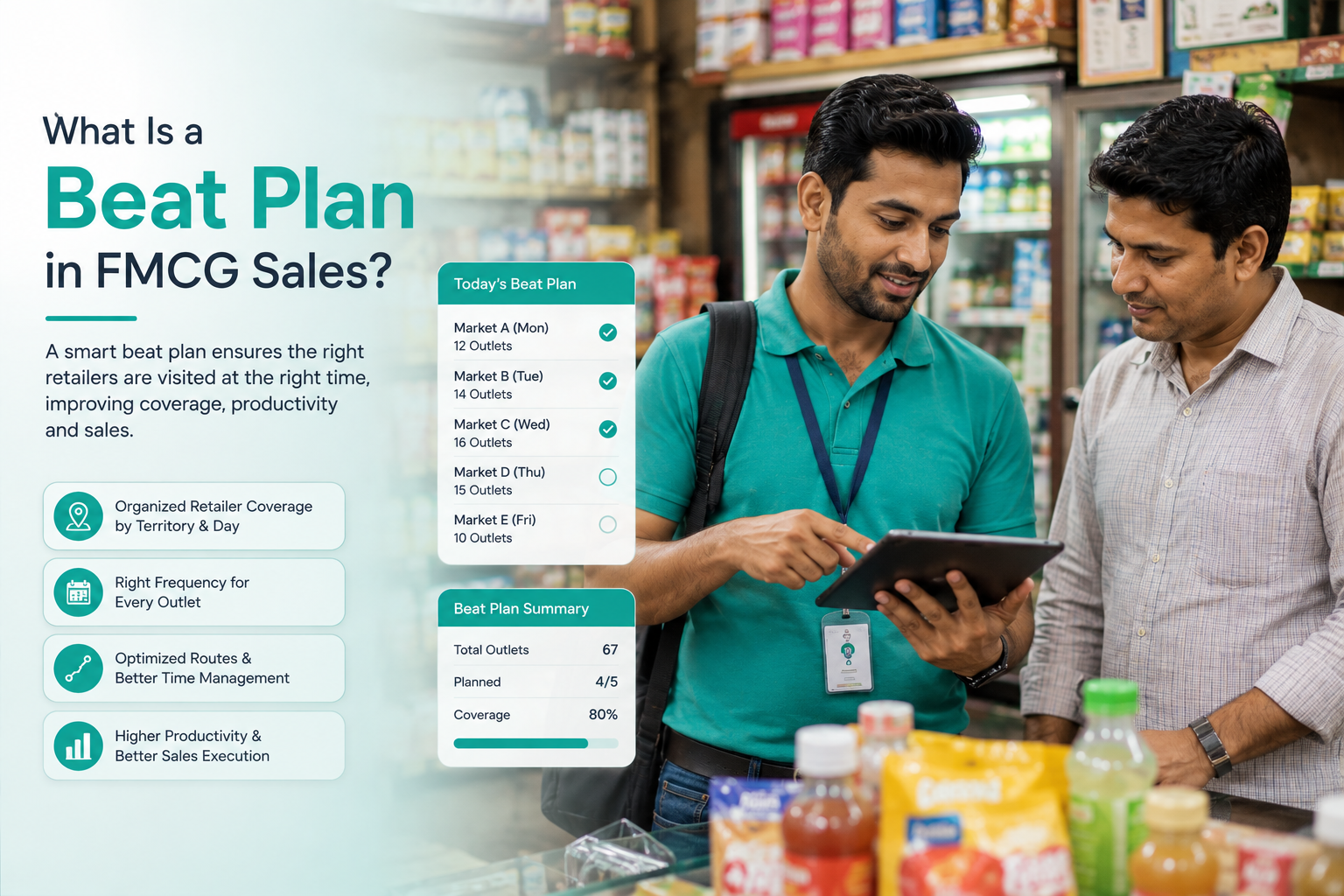
- Monday – Market A
- Tuesday – Market B
- Wednesday – Market C
- Thursday – Market D
- Friday – Market A
- Saturday – Market E
The objective is not simply to create a list of retailers. A good beat plan ensures that the right outlets are visited at the right frequency while minimizing unnecessary travel.
When combined with digital field sales automation, beat planning can become more dynamic, measurable, and easier to manage.
The Problem
FMCG companies often have extensive retail networks.
A single sales representative may need to manage:
- General trade outlets
- Kirana stores
- Supermarkets
- Wholesale outlets
- Distributors
- High-value retailers
- New outlets
- Promotional outlets
Without a structured beat plan, representatives may decide their daily visits based on convenience, memory, or informal instructions.
This can create several problems:
- Important retailers may be missed.
- Some outlets may be visited too frequently.
- Other outlets may not receive sufficient attention.
- Sales representatives may travel unnecessarily.
- Managers may not know which outlets were actually covered.
- New retailers may not be properly incorporated into routes.
- Sales opportunities can be missed.
As the retailer network grows, managing these activities manually becomes increasingly difficult.
Why It Happens
Several factors can make FMCG beat planning challenging.
1. Large Retailer Networks
FMCG companies may operate across thousands of outlets and multiple geographical areas.
Managing these outlets manually can quickly become complicated.
2. Geographically Distributed Markets
Retailers may be spread across different neighbourhoods, towns, districts, or territories.
Poor planning can result in unnecessary travel between outlets.
3. Changing Retailer Requirements
Retailer visit frequency may change based on:
- Sales volume
- Product category
- Outlet type
- Order frequency
- Market potential
- Promotional activities
A static plan may not always reflect these changes.
4. Manual Planning
When beat plans are maintained in spreadsheets or paper documents, updating routes and assigning outlets can take considerable time.
5. Limited Field Visibility
Managers may know what was planned but not necessarily what happened in the field.
This makes it difficult to measure planned visits versus actual visits.
Business Impact
Poor beat planning can affect both sales performance and operational efficiency.
Lower Outlet Coverage
When routes are not properly structured, some retailers may be missed.
Increased Travel Time
Representatives may spend more time traveling between outlets instead of interacting with retailers.
Lower Sales Productivity
A poorly planned day can reduce the number of productive retailer visits.
Missed Sales Opportunities
If high-potential or frequently ordering retailers are not visited at the right frequency, potential orders may be lost.
Inconsistent Market Execution
Promotions, merchandising activities, product launches, and retailer schemes may not be executed consistently.
Difficult Performance Measurement
Without a structured plan, managers may find it difficult to determine whether a representative completed the expected number of visits.
A good beat plan therefore becomes more than a route schedule—it becomes a framework for measuring field sales execution.
The Modern Solution
Modern FMCG companies can use digital beat planning and field sales automation software to create, manage, and monitor sales beats.
Instead of maintaining a spreadsheet containing retailer lists, managers can organize outlets digitally according to:
- Territory
- Distributor
- Sales representative
- Market
- Geography
- Retailer type
- Visit frequency
- Sales potential
The system can then assign retailers to specific beats and working days.
A typical workflow can look like:
Retailer Database → Territory Mapping → Beat Creation → Outlet Assignment → PJP → Daily Visits → Visit Verification → Performance Analysis
For example:
Beat 1 – Monday
15 retailers → Market A → Sales Representative 1
Beat 2 – Tuesday
18 retailers → Market B → Sales Representative 1
The representative can view the assigned outlets through a mobile application and follow the planned route.
Managers can then compare:
Planned Visits vs. Completed Visits vs. Missed Visits
This provides much better visibility into actual field execution.
Features of an Effective FMCG Beat Plan
1. Territory Management
A beat plan should allow companies to organize retailers according to territories, markets, distributors, and sales representatives.
This creates a clear structure for field operations.
2. Retailer Mapping
Each retailer can be mapped to a specific geographical location.
This helps managers understand the geographical distribution of outlets.
3. Outlet Assignment
Managers can assign specific retailers to individual sales representatives and beats.
4. Visit Frequency Management
Different retailers may require different visit frequencies.
For example:
- High-value retailer → 3 visits per week
- Medium-value retailer → 2 visits per week
- Low-volume retailer → 1 visit per week
This allows companies to allocate field resources according to business priorities.
5. Route Planning
The sequence of retailer visits can be organized to reduce unnecessary travel.
A well-planned route can help representatives spend more time selling and less time traveling.
6. PJP Integration
Beat plans can be connected with a Permanent Journey Plan (PJP).
The PJP defines the recurring schedule for markets and outlets, while the beat represents the specific set of outlets to be covered.
7. Planned vs. Actual Tracking
Managers can compare the outlets assigned to a representative with the outlets actually visited.
This helps identify coverage gaps.
8. GPS-Based Visit Verification
Location-based verification can help confirm that a representative visited the assigned retailer.
This provides stronger visibility than manually submitted visit reports.
9. Order Capture
Representatives can capture retailer orders during their planned visits.
This connects beat execution directly with sales activity.
10. Performance Dashboards
Managers can monitor metrics such as:
- Planned outlets
- Visited outlets
- Missed outlets
- Coverage percentage
- Orders generated
- Sales value
- Representative productivity
- Beat adherence
Benefits of Beat Planning in FMCG
1. Better Retailer Coverage
A structured beat ensures that important retailers are not forgotten.
2. Improved Sales Productivity
Representatives can spend more time on productive retailer interactions instead of deciding where to go next.
3. Reduced Travel
Logical geographical grouping can reduce unnecessary movement between outlets.
4. Consistent Visit Frequency
Companies can ensure retailers receive visits according to their business requirements.
5. Better Market Coverage
Managers can identify areas where retailer coverage is weak and make adjustments.
6. Improved Accountability
A clearly defined plan makes it easier to measure whether assigned visits were completed.
7. Faster Decision-Making
Digital beat data gives managers timely information about field execution.
8. Better Sales Planning
Historical visit and order data can help businesses understand which markets and outlets generate better results.
9. Easier Team Management
Managers can assign, update, and monitor beats without relying heavily on spreadsheets or manual communication.
10. Scalable Field Operations
Digital beat planning becomes especially valuable when the number of sales representatives, territories, and retailers increases.
Industry Use Cases
General Trade
Beat planning is particularly important for FMCG general trade, where sales representatives may visit large numbers of small retailers.
A structured beat helps ensure consistent coverage of kirana stores and other retail outlets.
Food & Beverage
Sales representatives can use beats to manage retailer visits, orders, stock checks, and merchandising activities.
Personal Care
Beat plans can help teams manage retailers, product displays, promotions, and new product launches.
Home Care
Sales teams can organize retailer visits based on territory, product demand, and order frequency.
Dairy
Beat planning can help manage frequent retailer and distributor interactions across geographically distributed markets.
New Product Launches
Companies can create temporary or campaign-specific beats to ensure new products reach target outlets.
Retail Activation
Field teams can use beat plans to organize visits for branding, POSM placement, promotions, and photographic verification.
Distributor Sales
Beat planning can also help companies coordinate sales representatives working with distributor networks and assigned markets.
Beat Plan vs. PJP: What Is the Difference?
Beat plans and PJPs are closely related but are not exactly the same.
Beat Plan
PJP
Defines a group of outlets or route
Defines the recurring visit schedule
Focuses on outlet/route coverage
Focuses on when visits should happen
Can represent a specific market or route
Usually covers a longer planning cycle
Helps organize daily field activity
Helps establish recurring field activity
For example:
PJP:
Every Monday → Market A
Beat Plan:
Market A → Retailers 1, 2, 3, 4, 5, 6...
Together, they provide a structured approach to field sales planning.
How FMCG Companies Can Create an Effective Beat Plan
Step 1: Build an Accurate Retailer Database
Start with accurate retailer names, locations, categories, distributors, and sales information.
Step 2: Map Retailers Geographically
Group retailers according to their actual locations.
Step 3: Classify Retailers
Consider factors such as:
- Sales potential
- Order frequency
- Outlet type
- Product category
- Market importance
Step 4: Determine Visit Frequency
Decide how often each retailer needs to be visited.
Step 5: Create Geographical Beats
Group nearby retailers into practical routes.
Step 6: Assign Sales Representatives
Assign beats according to territory, workload, and representative availability.
Step 7: Connect Beats With the PJP
Create a recurring schedule for the assigned beats.
Step 8: Track Actual Execution
Monitor whether representatives complete their planned visits.
Step 9: Analyze Performance
Compare coverage, orders, sales, and productivity across beats.
Step 10: Optimize Regularly
A beat plan should not remain unchanged forever. Retailer locations, sales volumes, market conditions, and team structures can change.
Regular optimization helps keep the plan effective.
Conclusion
A beat plan in FMCG sales is a structured way of organizing retailer visits so sales representatives know where to go, when to go, and which outlets to prioritize.
A well-designed beat plan can improve retailer coverage, reduce unnecessary travel, increase sales productivity, and create greater consistency in field execution.
However, creating the plan is only the first step.
The real value comes from connecting beat planning with PJP management, route planning, retailer visit tracking, GPS-based verification, order capture, merchandising, and performance analytics.
With digital field sales automation, FMCG companies can move from simply planning retailer visits to continuously measuring and improving field execution.
The result is a more organized sales force, better retailer coverage, stronger market execution, and a scalable approach to FMCG sales management.