Introduction
For FMCG companies, sales performance depends heavily on how effectively field sales representatives visit outlets, collect orders, maintain product availability, execute merchandising activities, and achieve their targets.
However, managing a large FMCG sales team across multiple territories is challenging when managers cannot see field activities in real time. Traditional spreadsheets, phone calls, WhatsApp updates, and end-of-day reports provide limited visibility into what is actually happening in the market.
Real-time FMCG sales tracking software provides a smarter way to monitor sales representatives, outlet visits, sales activities, routes, and performance from a centralized dashboard.
With features such as GPS tracking, field force management, sales visit tracking, outlet coverage monitoring, attendance tracking, and real-time reports, FMCG companies can identify performance gaps faster and make data-driven decisions.
This guide explains how to track FMCG sales team performance in real time, which KPIs to monitor, the problems with manual tracking, and how field sales automation software can improve sales execution.
The Problem: FMCG Sales Teams Are Difficult to Monitor
FMCG sales representatives spend most of their working day outside the office. They travel across markets, visit retailers, collect orders, check product availability, execute promotions, and interact with distributors.
For sales managers, this creates several challenges:
- Limited visibility into field activities
- Difficulty tracking sales representatives in real time
- Delayed sales reports
- Unclear outlet coverage
- Missed retailer visits
- Difficulty verifying field visits
- Poor visibility into sales targets
- Inefficient routes and excessive travel
- Difficulty comparing representatives
- Delayed identification of underperformance
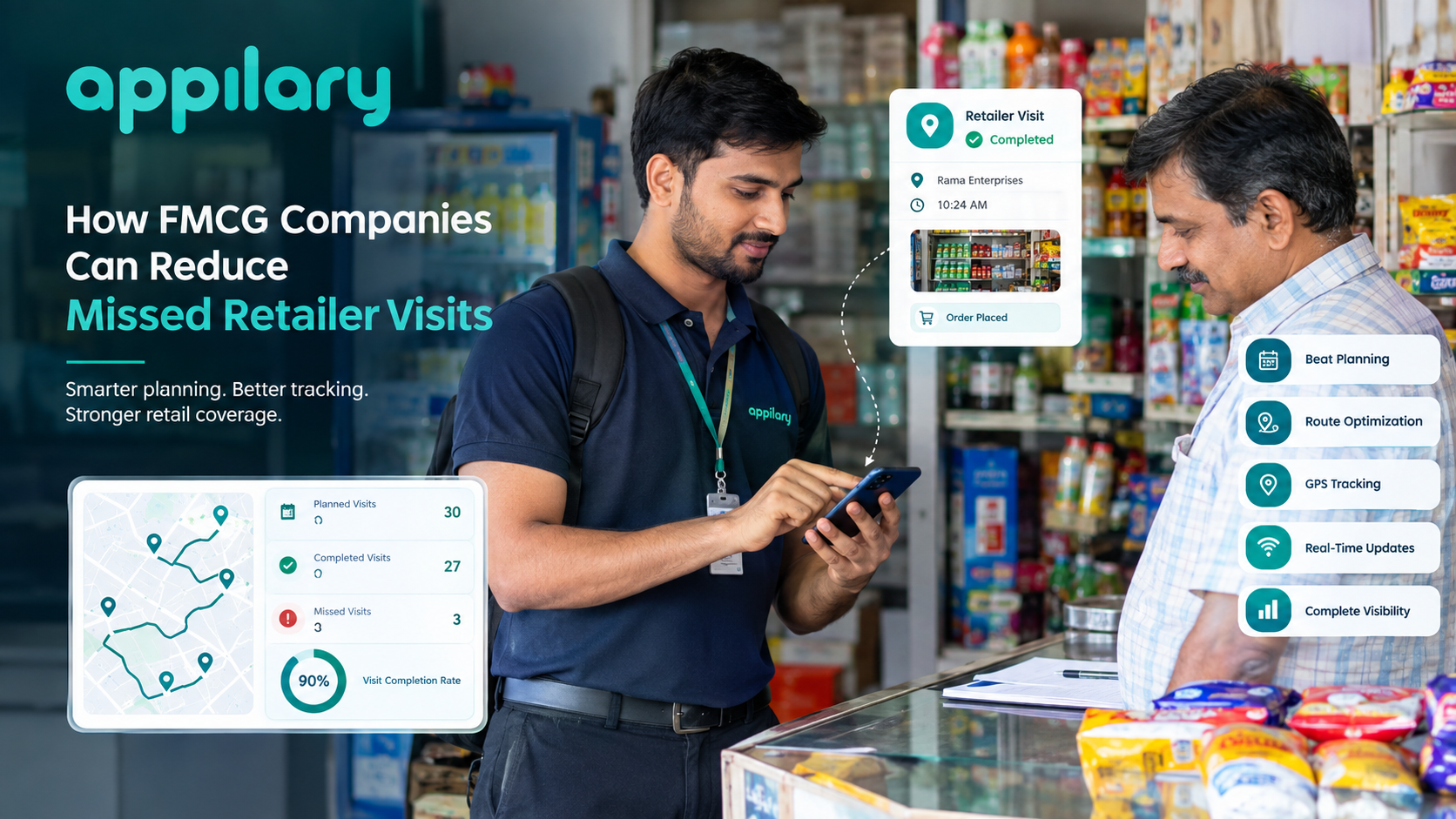
For example, a manager may know that a sales representative was assigned to visit 30 outlets, but without digital tracking, it can be difficult to determine how many outlets were actually visited and what activities were completed.
Why Does FMCG Sales Performance Tracking Become Difficult?
1. Sales Teams Work Across Large Territories
FMCG representatives may cover hundreds of retailers across cities, districts, markets, and rural areas.
Monitoring every field activity manually becomes difficult as the sales force grows.
2. Field Activity Happens Away From the Office
Managers cannot physically accompany every salesperson throughout the day.
They need digital visibility into field execution.
3. Manual Reports Are Delayed
When representatives submit reports at the end of the day, managers may discover problems only after valuable selling time has already been lost.
4. Sales and Field Activity Data Are Often Separate
Sales orders, outlet visits, attendance, GPS information, and target achievement may be stored in different systems or spreadsheets.
This makes it difficult to understand overall performance.
5. Planned Activities May Differ From Actual Activities
A representative may have a planned beat containing 25 outlets but visit only 18.
Without planned vs. actual visit tracking, managers may not identify the gap immediately.
Business Impact of Poor FMCG Sales Performance Tracking
Poor visibility into field sales activities can affect several areas of the business.
Lower Outlet Coverage
Missed retailer visits can reduce opportunities to collect orders and maintain product availability.
Reduced Sales Productivity
Sales representatives may spend excessive time travelling or visiting low-priority outlets.
Missed Sales Opportunities
Managers may discover missed opportunities only after the sales day is over.
Higher Operational Costs
Inefficient routes and unnecessary travel can increase field operating costs.
Difficult Performance Management
Without reliable field data, it becomes harder to identify high performers, underperforming territories, and execution gaps.
Delayed Decision-Making
Managers need current information to make timely decisions about territories, targets, routes, and sales activities.
The Modern Solution: Real-Time FMCG Sales Tracking Software
The modern approach is to use FMCG sales tracking software or field sales automation software that connects field representatives, outlets, sales activities, GPS information, and performance data in one platform.
Instead of waiting for end-of-day reports, managers can use a centralized dashboard to monitor field execution throughout the working day.
A typical workflow looks like:
Assign Targets → Create Beat Plan → Track Field Visits → Record Sales → Monitor Performance → Analyze Reports → Optimize
This creates greater visibility across the entire FMCG sales force.
How to Track FMCG Sales Team Performance in Real Time
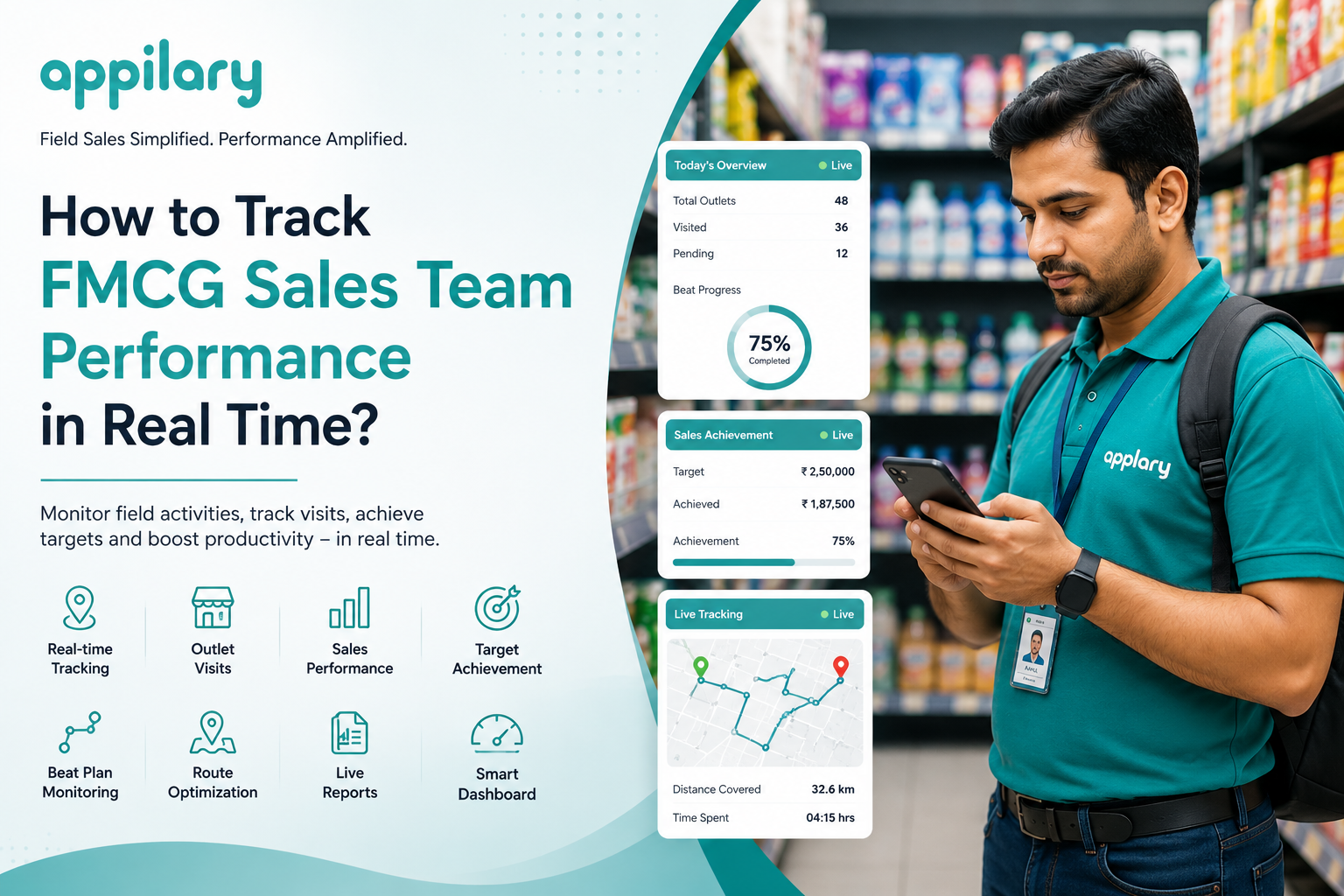
1. Track Sales Representative Locations
GPS-based sales team tracking helps managers understand where field representatives are working.
Depending on the system configuration, managers can monitor:
- Current field activity
- Visit locations
- Route movement
- Distance travelled
- Outlet locations
- Visit timestamps
Location tracking should be implemented transparently and according to applicable privacy requirements and company policies.
2. Monitor Planned vs. Actual Visits
A strong FMCG field sales management system should compare the day's planned outlet visits with actual visits.
Managers can track:
- Planned outlets
- Visited outlets
- Missed outlets
- Additional outlets visited
- Visit timing
- Visit duration
This helps identify FMCG outlet coverage gaps quickly.
3. Track Sales Targets and Achievement
Sales performance should not be measured only by the number of visits.
Managers can monitor:
- Daily sales target
- Achieved sales
- Target achievement percentage
- Orders collected
- Average order value
- Productive calls
- Outlet-wise sales
This provides a clearer picture of salesperson productivity.
4. Monitor Beat Completion
A digital FMCG beat plan allows managers to track whether representatives are completing their assigned routes.
For example:
Planned outlets: 25
Visited outlets: 21
Missed outlets: 4
Beat completion: 84%
This helps managers identify field execution problems before they become recurring issues.
5. Track Productive Calls
Not every outlet visit produces an order.
Therefore, managers should compare total visits with productive visits.
For example:
Total outlet visits: 25
Productive calls: 18
Productivity rate: 72%
This provides more useful information than simply counting visits.
6. Monitor Sales Representative Attendance
Attendance tracking can be integrated with field activity to provide better visibility into the working day.
Managers can compare:
Attendance → Field Activity → Outlet Visits → Sales → Target Achievement
This creates a more complete picture of field sales performance.
7. Analyze Sales Reports in Real Time
A centralized FMCG sales dashboard can bring important information together.
Managers can analyze:
- Sales by representative
- Sales by territory
- Sales by distributor
- Sales by outlet
- Target vs. achievement
- Outlet coverage
- Productive calls
- Beat completion
- Visit activity
- Daily performance
Key Features of FMCG Sales Performance Tracking Software
GPS Field Force Tracking
GPS tracking provides location-based visibility into field sales activities and can support outlet visit verification.
Real-Time Sales Tracking
Managers can monitor sales activities and performance without waiting for manual end-of-day reports.
Outlet Visit Tracking
Digital visit records can capture outlet visits, timestamps, locations, and relevant sales activities.
Beat Planning
Managers can create and assign daily or weekly beats based on territories, outlet locations, and visit frequency.
Route Monitoring
Route visibility helps managers identify inefficient movement and understand travel patterns.
Target Management
Sales managers can assign targets and monitor achievement across representatives, territories, products, and outlets.
Automated Reports
Reports can provide insights into field visits, sales, outlet coverage, targets, and representative performance.
Real-Time Dashboards
A centralized dashboard can help managers quickly identify:
- Top performers
- Underperforming representatives
- Low-coverage territories
- Missed visits
- Sales gaps
- Target achievement
Geo-Verification
Location-based verification can help confirm that a representative reached the assigned outlet before recording a visit.
Important KPIs to Track for FMCG Sales Teams
Tracking the right FMCG sales KPIs is essential for understanding field performance.
1. Sales Target Achievement
Measures how much of the assigned sales target has been achieved.
2. Outlet Coverage
Measures the percentage of assigned outlets actually visited.
3. Beat Completion Rate
Shows how successfully representatives completed their planned beat.
4. Productive Call Rate
Measures how many outlet visits resulted in productive sales activity.
5. Average Order Value
Shows the average value generated per order.
6. Sales Per Representative
Helps compare sales productivity across the field team.
7. Missed Visit Rate
Identifies the percentage of planned visits that were not completed.
8. Visit Frequency
Shows how regularly important retailers are being visited.
9. Travel Distance
Helps identify inefficient routes and excessive field movement.
10. Target vs. Achievement
Provides a quick comparison between expected and actual sales performance.
Benefits of Real-Time FMCG Sales Team Tracking
Better Sales Visibility
Managers can get a clearer view of field activities instead of relying entirely on delayed reports.
Faster Problem Identification
If a representative is falling behind on planned visits or sales targets, managers can identify the issue earlier.
Improved Sales Productivity
Performance data helps managers understand how representatives are spending their working time.
Better Outlet Coverage
Digital beat and visit tracking helps reduce missed retailer visits.
Improved Territory Management
Managers can identify territories that need additional resources, route changes, or revised targets.
Reduced Manual Reporting
Automated digital records reduce dependence on spreadsheets and manually prepared reports.
Data-Driven Decision-Making
Managers can use actual field data to make decisions about sales targets, routes, territories, and outlet priorities.
Greater Accountability
Clear records of planned activities and actual execution create greater transparency between field teams and managers.
Industry Use Cases
FMCG General Trade
Sales representatives can track visits to kirana stores, independent retailers, wholesalers, and distributors.
Food and Beverage Companies
Field teams can monitor outlet visits, order collection, product availability, merchandising, and promotional activities.
Personal Care and Home Care
Companies can track retailer coverage and sales execution across multiple territories.
Consumer Durables
Field representatives can use sales tracking and visit management for dealer and retailer networks.
Distributor Sales Teams
Distributors can monitor salesperson routes, retailer visits, orders, and territory performance.
Large Field Sales Organizations
Companies with hundreds or thousands of field employees can centralize sales performance data through a field force management software platform.
Manual Tracking vs. Real-Time FMCG Sales Tracking
Manual Sales Tracking
- Spreadsheet-based reporting
- End-of-day updates
- Limited GPS visibility
- Manual visit records
- Delayed performance analysis
- Difficult territory monitoring
- Higher risk of inaccurate information
- Difficult to scale
Real-Time Sales Tracking Software
- Digital sales monitoring
- Faster field activity visibility
- GPS-based tracking
- Automated visit records
- Real-time dashboards
- Planned vs. actual visit tracking
- Automated performance reports
- Scalable for large sales teams
How Real-Time Tracking Improves FMCG Sales
Real-time tracking is not simply about knowing where a salesperson is.
The real objective is to connect field activity with business performance.
For example:
GPS Location → Outlet Visit → Sales Activity → Order → Revenue → Performance Report
This allows managers to understand not only whether a representative visited an outlet, but also whether the visit contributed to productive sales activity.
By combining FMCG sales tracking, field force management, beat planning, outlet management, and sales analytics, companies can build a more measurable and efficient sales operation.
Conclusion
Tracking FMCG sales team performance in real time gives managers greater visibility into what is happening in the field.
Traditional methods such as spreadsheets, phone calls, WhatsApp updates, and end-of-day reports can make it difficult to monitor large field teams efficiently. FMCG sales tracking software provides a centralized way to monitor sales representatives, outlet visits, GPS activity, beat completion, sales targets, and field performance.
The most effective approach is to measure more than just sales. Companies should track outlet coverage, productive calls, planned vs. actual visits, beat completion, target achievement, visit frequency, and sales productivity.
When these metrics are available through a real-time dashboard, FMCG managers can identify gaps faster, improve field execution, and make better decisions.
Want better visibility into your FMCG sales team's field performance? Use field sales automation software to track sales activities, monitor outlet coverage, manage beats, and turn real-time field data into actionable sales insights.