Introduction
FMCG companies depend heavily on their field sales representatives. Every day, sales representatives travel through assigned markets, visit retailers, take orders, check product availability, monitor displays, communicate schemes, and maintain relationships with distributors and retailers.
But for a sales manager sitting at the regional or head office, one question can be difficult to answer:
"What is actually happening in the field today?"
Traditional methods such as phone calls, WhatsApp updates, spreadsheets, paper reports, and end-of-day submissions provide only limited visibility. By the time a manager receives the information, the opportunity to correct a missed visit, inefficient route, or poor market coverage may already be gone.
This is why FMCG companies increasingly use field sales tracking software and Sales Force Automation (SFA) to manage field representatives.
Modern tracking is not simply about seeing a salesperson's location on a map. A complete system connects location and attendance with planned visits, retailer coverage, orders, activities, and performance. Industry solutions commonly combine GPS attendance, beat planning, outlet visit verification, order capture, and dashboards into one workflow.
The Problem
FMCG sales representatives often manage dozens of retailer visits across different markets in a single working day.
Without a centralized tracking system, managers may face questions such as:
- Did the sales representative start the day on time?
- Which market did they visit?
- Which retailers were actually covered?
- Were the planned outlets visited?
- How much time was spent at each outlet?
- Were orders captured correctly?
- Was the required merchandising activity completed?
- Which outlets were skipped?
- Did the representative follow the assigned beat?
- How is the representative performing against the target?
When this information is collected manually, managers often have to depend on self-reported updates.
For example, a salesperson may report that 20 retailers were visited. A spreadsheet may show the same number. However, without digital verification, the manager may not know whether all 20 outlets were actually visited or whether some visits were entered later.
The challenge becomes even larger when a company has hundreds of sales representatives operating across multiple cities, states, distributors, and territories.
Why It Happens
The main reason is that field sales operations are often managed through disconnected processes.
A typical traditional workflow may look like:
Salesperson → Phone/WhatsApp Update → Spreadsheet → Manager → Manual Report → Head Office
Each step creates the possibility of delays or inaccurate information.
1. Manual Attendance
Sales representatives may record attendance manually or communicate their start-of-day status through messages.
2. Unstructured Visit Reporting
Retailer visits may be recorded in paper registers, spreadsheets, or end-of-day reports.
3. Poor Route Visibility
Managers may know the assigned route but have limited visibility into whether the actual route followed matches the plan.
4. Delayed Order Reporting
Orders captured during the day may reach managers or distributors only after manual reporting.
5. Multiple Communication Channels
Information can be scattered across WhatsApp messages, calls, Excel files, photographs, and emails.
6. Lack of Centralized Data
When attendance, visits, orders, and performance are stored separately, managers cannot easily connect field activity with sales outcomes.
This is why modern FMCG tracking systems focus on field activity visibility, rather than GPS alone.
Business Impact
Poor visibility into field sales activity can affect several areas of an FMCG business.
Reduced Retailer Coverage
If planned outlets are missed, product availability and retailer engagement can suffer.
Lower Sales Productivity
Sales representatives can spend significant time on manual reporting, route-related administration, and repetitive communication instead of selling.
Delayed Decisions
Managers working with yesterday's data may not be able to correct today's problems.
Inefficient Routes
Poor route planning can increase travel time and reduce the number of productive retailer visits.
Inconsistent Execution
Promotions, merchandising activities, new product launches, and retailer schemes may not be executed consistently across markets.
Weak Performance Visibility
Managers may struggle to distinguish between high activity, productive activity, and low-value activity.
A modern field sales system helps connect planned activity → actual execution → sales outcome, giving managers a much clearer operational picture.
The Modern Solution
The modern approach is to use a Field Sales Tracking App or Sales Force Automation platform.
Instead of tracking only where representatives are, the system tracks the complete field sales workflow.
A typical workflow looks like:
Attendance → Beat Plan → Route → Retailer Visit → Geo Verification → Order Capture → Activity Reporting → Dashboard → Performance Analysis
For example, when a sales representative begins the day, the application can record attendance with appropriate time and location verification.
The representative then receives the day's assigned beat or Permanent Journey Plan (PJP).
At each retailer, the representative can check in, capture the visit, record orders, update stock or product information, complete merchandising activities, and submit photographs where required.
The information is then available to managers through dashboards and reports.
This changes tracking from:
"Where is my sales representative?"
to:
"What is my sales representative doing, which outlets have been covered, and what business activity has been generated?"
That distinction is important.
A GPS tracker provides location information. A field sales automation platform provides operational visibility.
Features of FMCG Sales Representative Tracking Software
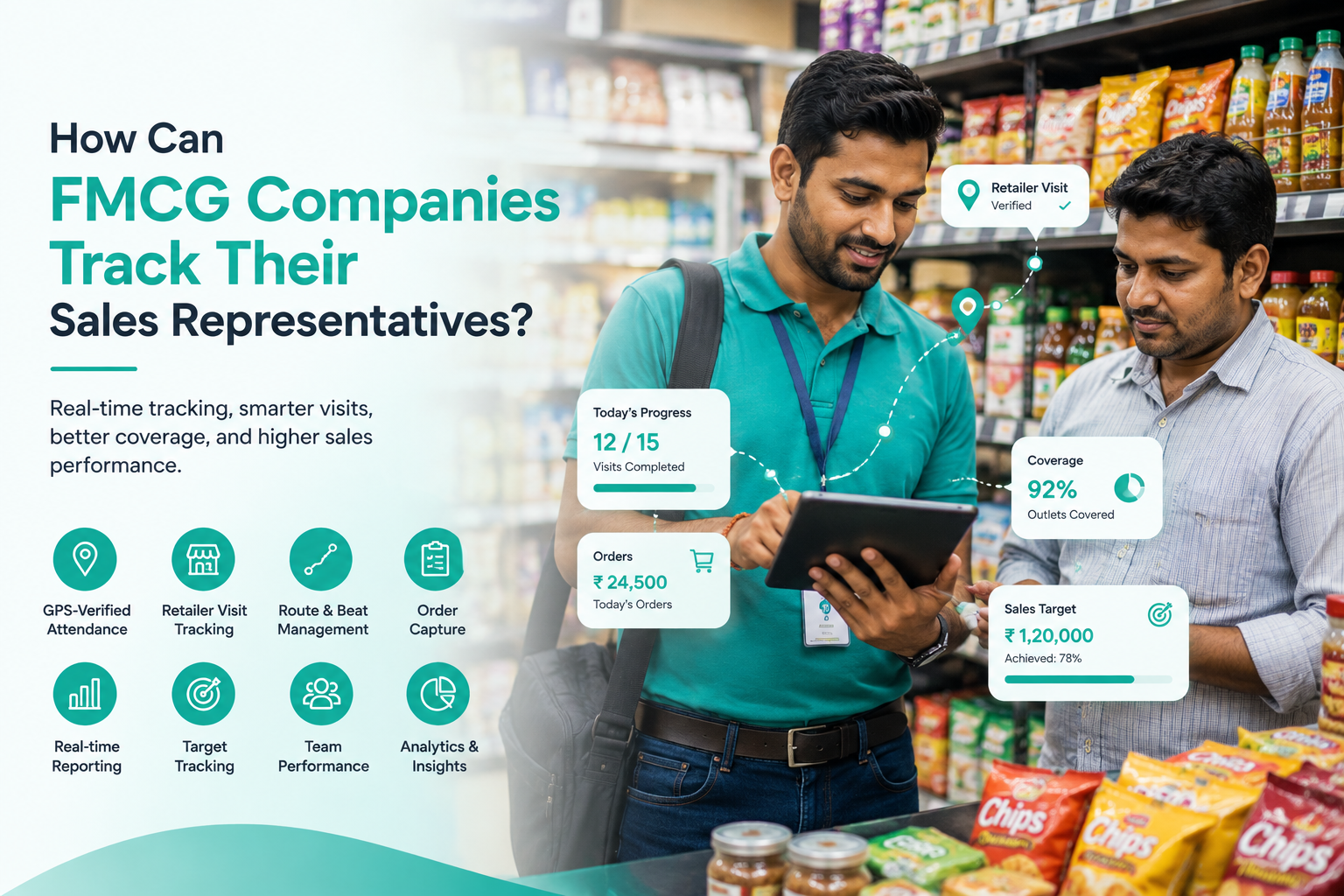
1. GPS-Verified Attendance
Sales representatives can mark attendance through a mobile application with time and location information.
This provides greater visibility into when and where the working day started.
2. Live Location Tracking
Managers can view field team locations where continuous tracking is appropriate and permitted.
This can help managers understand whether representatives are moving through their assigned markets and identify operational delays.
However, responsible tracking should be designed around business needs and applicable privacy requirements rather than unnecessary surveillance.
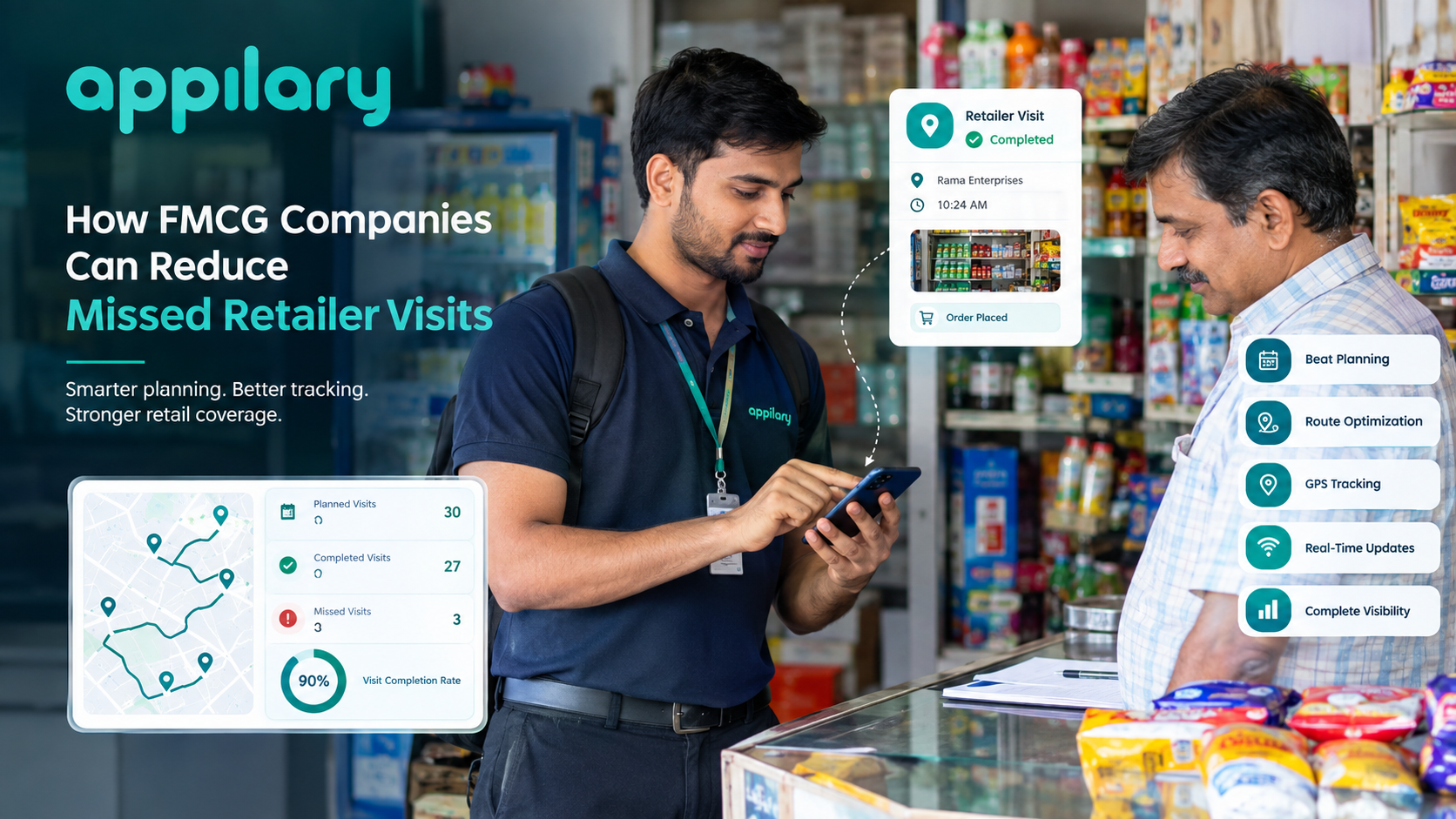
3. Retailer Visit Tracking
Every planned retailer visit can be recorded digitally.
The system can capture:
- Retailer name
- Visit time
- Location
- Visit status
- Order information
- Activity details
- Photos
- Remarks
This creates a structured history of field interactions.
4. Geo-Fenced Visit Verification
Geo-verification can help confirm that a representative was physically present at the expected retailer location.
This is particularly useful when businesses need reliable outlet coverage data.
5. Beat Planning
Managers can create beats that define the retailers a representative should cover within a particular territory.
Digital beat planning helps compare planned visits versus actual visits. Beat planning is widely treated as a core part of FMCG field sales execution.
6. PJP Management
A Permanent Journey Plan organizes recurring retailer visits according to territory, route, frequency, and assigned days.
For example:
Monday → Market A
Tuesday → Market B
Wednesday → Market C
This makes retailer coverage more structured.
7. Route Planning
Route planning helps sales representatives organize their daily visits efficiently.
Managers can also identify inefficient routes and improve territory planning.
8. Order Capture
Representatives can enter retailer orders directly through the mobile application.
Instead of sending order details through WhatsApp or entering them into spreadsheets later, the order can be captured at the point of sale.
9. Sales and Target Tracking
Managers can compare individual and team performance against assigned targets.
Useful metrics can include:
- Target vs achievement
- Orders booked
- Outlet productivity
- Sales value
- Product-wise performance
- Territory performance
- Representative performance
10. Real-Time Dashboards
A centralized dashboard can provide managers with an overview of:
- Attendance
- Active representatives
- Planned visits
- Completed visits
- Missed visits
- Outlet coverage
- Orders
- Sales performance
- Beat adherence
This reduces dependence on manually prepared daily reports.
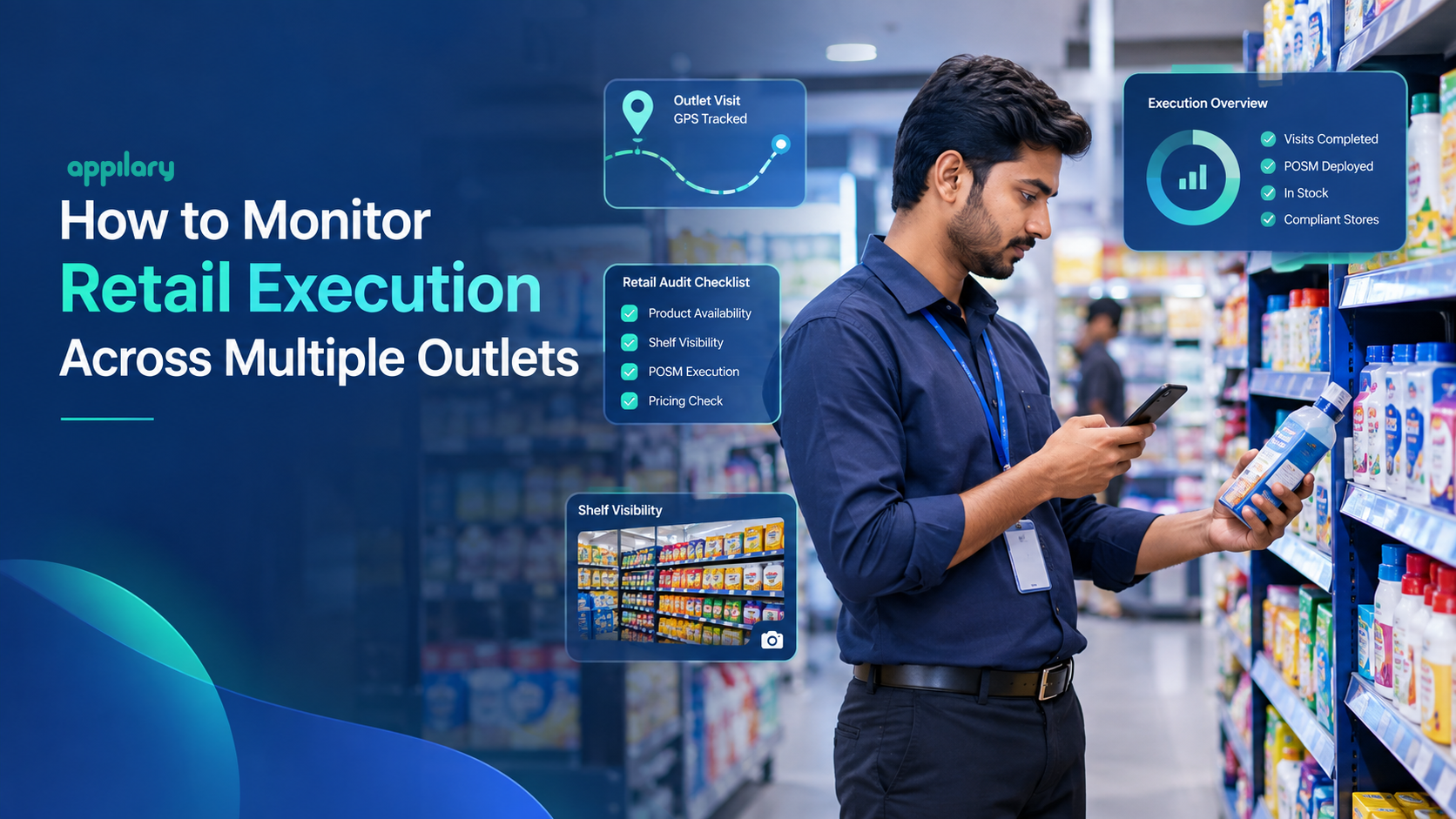
11. Merchandising and Retail Execution
FMCG representatives can capture information about:
- Product availability
- Shelf placement
- POSM
- Displays
- Promotions
- Competitor presence
- Store branding
Photographic evidence can also be attached to relevant activities.
12. Automated Reporting
Instead of manually combining multiple spreadsheets, field data can automatically feed daily, weekly, and monthly reports.
This allows managers to spend less time collecting information and more time analyzing it.
Benefits of Tracking FMCG Sales Representatives
Better Field Visibility
Managers gain a clearer understanding of what is happening across territories and markets.
Improved Retailer Coverage
Beat plans and visit tracking help teams identify missed outlets and coverage gaps.
Higher Productivity
Automation reduces repetitive administrative work and helps representatives focus more on retailer interactions.
Faster Decision-Making
Real-time or timely field information allows managers to respond to issues sooner.
Better Route Efficiency
Digital route planning can help representatives organize visits more effectively.
Improved Accountability
Planned activities can be compared with actual execution using measurable data.
More Accurate Reporting
Digital data capture reduces dependence on manually prepared reports.
Better Sales Analysis
Managers can connect field activity with orders, sales targets, retailer coverage, and territory performance.
Scalable Field Operations
A centralized platform makes it easier to manage larger sales teams across multiple territories.
Industry Use Cases
1. FMCG Distribution
FMCG companies can track retailer visits, orders, attendance, beats, sales activity, and market coverage.
2. Food & Beverage
Field teams can monitor product availability, retailer orders, merchandising, and promotional execution.
3. Dairy
Sales representatives can manage distributor and retailer visits, product availability, orders, and territory coverage.
4. Personal Care
Teams can track product displays, retailer visits, new product launches, and promotional activities.
5. Home Care
Field representatives can monitor retailer coverage, SKU availability, orders, and competitor activity.
6. New Product Launches
Companies launching new SKUs can track whether assigned outlets have been visited and whether products have been introduced or displayed.
7. Retail Activation
Field teams can capture photographic proof of branding, displays, promotional materials, and campaign execution.
8. Distributor and Channel Management
Companies can use field data to understand market coverage, distributor performance, retailer activity, and secondary sales execution.
Modern SFA platforms increasingly combine these activities rather than treating tracking, sales, reporting, and merchandising as completely separate processes.
How Should FMCG Companies Implement Sales Representative Tracking?
Tracking technology works best when it is introduced as an operational improvement, not simply an employee-monitoring exercise.
A practical implementation can follow these steps:
Step 1: Define the Business Objectives
Decide what the company actually wants to improve.
For example:
- Retailer coverage
- Sales productivity
- Attendance
- Beat adherence
- Order capture
- Reporting
- Route efficiency
Step 2: Map Territories and Retailers
Create accurate territory, distributor, beat, and retailer data before implementing the system.
Step 3: Define the Field Workflow
Decide what representatives need to complete during each visit.
Step 4: Select the Right Tracking Features
Choose features according to business requirements rather than selecting a system based only on GPS tracking.
Step 5: Train the Field Team
Representatives should understand how the application reduces reporting work and helps them manage their daily activities.
Step 6: Start With a Pilot
Test the system with a small group of representatives or one territory before a wider rollout.
Step 7: Measure Results
Monitor metrics such as outlet coverage, visit completion, order productivity, reporting time, and target achievement.
This approach makes technology adoption more practical and helps businesses identify what actually improves field execution.
Conclusion
So, how can FMCG companies track their sales representatives?
The most effective approach is not simply installing a GPS tracker. FMCG companies should use a field sales tracking and automation system that connects representative location and attendance with retailer visits, beat plans, routes, orders, merchandising activities, reporting, and performance.
The real value comes from understanding the complete field operation.
Managers should be able to see:
Who is working → Which market they are covering → Which retailers they visited → What happened at each outlet → What orders were generated → How performance compares with targets.
When this information is available through one centralized system, FMCG businesses can improve field visibility, retailer coverage, productivity, reporting accuracy, and sales execution.
The future of FMCG field management is therefore moving from "tracking people" to "measuring field execution."
A well-designed system gives managers the visibility they need while giving sales representatives better tools to plan their day, manage retailers, capture orders, and spend more time selling.