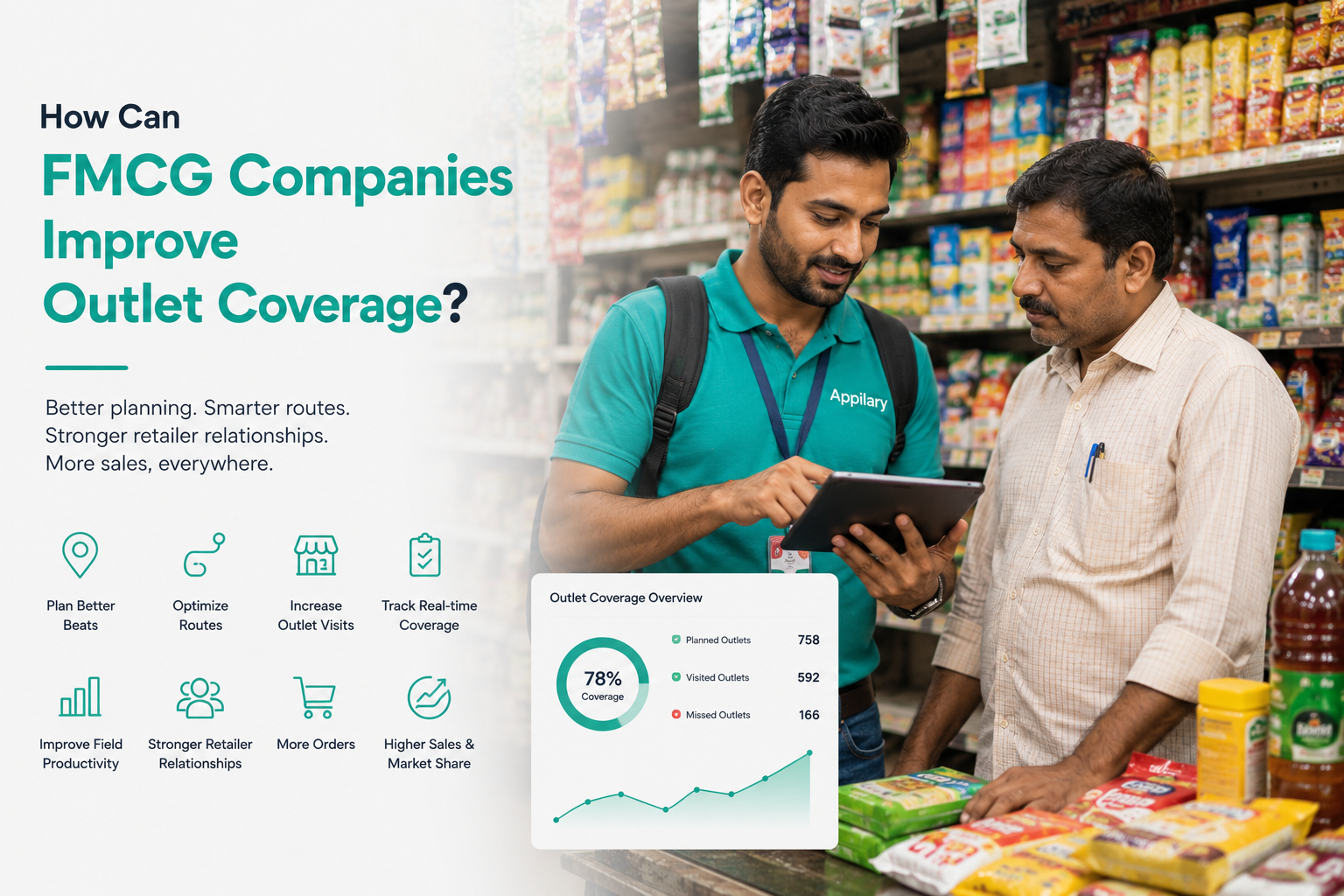
Introduction
For an FMCG company, having products available in the market is only one part of the sales equation. The sales team must also ensure that the right retailers are visited at the right frequency, products are available, orders are captured, and promotions are executed consistently.
This makes outlet coverage a critical part of FMCG sales management.
Outlet coverage refers to the extent to which a company's sales representatives successfully reach and serve the retailers or outlets assigned to them. It includes not only the number of outlets visited but also whether the right outlets are being visited at the right frequency and whether productive sales activities are completed during those visits.
For example, if a sales representative is assigned 100 retailers but regularly visits only 70, the company may have a 70% basic visit coverage. However, simply increasing the number of visits is not always the answer. High-value outlets may require more frequent visits, while low-volume outlets may require less frequent coverage.
Therefore, improving outlet coverage requires a combination of retailer planning, territory management, beat planning, route optimization, field execution, and performance measurement.
The Problem
FMCG companies often manage large and geographically distributed retailer networks.
A sales representative may be responsible for:
- Kirana stores
- Supermarkets
- Wholesale outlets
- Distributors
- New retailers
- High-value outlets
- Promotional outlets
- Retailers across multiple markets
When these outlets are managed manually, achieving consistent coverage becomes difficult.
Some common problems include:
- Planned retailers being missed
- Sales representatives spending too much time travelling
- Uneven visit frequency
- Poorly structured beats
- Duplicate or outdated retailer records
- New outlets not being added to routes
- Limited visibility into actual visits
- Difficulty comparing planned and completed visits
- Manual reporting delays
- Poor coordination between sales representatives and managers
For example, a company may have 5,000 registered retailers but discover that only a portion are regularly visited.
The issue is not necessarily the size of the retailer network. It is often the lack of a structured system for prioritizing, assigning, visiting, and monitoring outlets.
Why It Happens
Several operational challenges can contribute to poor outlet coverage.
1. Poor Beat Planning
If retailers are not grouped logically by location, representatives may spend too much time travelling between outlets.
A poorly designed beat can reduce the number of productive visits a representative can complete in a day.
2. No Clear Visit Frequency
Every retailer does not necessarily require the same visit frequency.
A high-volume retailer may need multiple visits each week, while another outlet may only require weekly or fortnightly coverage.
Without segmentation, companies may distribute field resources inefficiently.
3. Outdated Retailer Data
Retailers may:
- Change locations
- Close permanently
- Change ownership
- Become inactive
- Change their business category
If the retailer database is not regularly updated, representatives may waste time visiting inactive or incorrect outlets.
4. Manual Route Planning
Planning routes manually using spreadsheets or maps can become difficult as the number of retailers increases.
5. Limited Field Visibility
Managers may know how many outlets were assigned but may not have timely visibility into how many were actually visited.
6. New Outlets Are Not Added Quickly
New retail opportunities can be missed when there is no simple process for identifying and adding new outlets to the sales network.
7. Too Much Administrative Work
When representatives spend significant time preparing reports, updating spreadsheets, or communicating visit information manually, less time remains for retailer interactions.
Business Impact
Poor outlet coverage can affect several areas of FMCG business performance.
Lost Sales Opportunities
If retailers are not visited regularly, representatives may miss opportunities to capture orders, introduce new products, or address stock issues.
Lower Product Availability
Infrequent retailer visits can make it harder to identify stock shortages and replenishment requirements.
Weak Retailer Relationships
Regular interaction is important for maintaining retailer relationships and understanding changing market requirements.
Lower Sales Productivity
Excessive travel and inefficient routes reduce the amount of time representatives can spend on productive sales activities.
Poor Promotional Execution
Retail promotions, displays, POSM, and new product launches require consistent field execution.
When outlets are missed, promotional activities may also be missed.
Difficulty Measuring Performance
Without accurate coverage data, managers may struggle to understand whether poor sales are caused by demand, distribution, execution, or insufficient retailer coverage.
The Modern Solution
The modern approach to improving outlet coverage is to combine structured sales planning with field sales automation.
Instead of treating every retailer equally, FMCG companies can organize their outlets according to factors such as:
- Location
- Sales potential
- Order frequency
- Retailer type
- Product category
- Market importance
- Historical sales
- Visit requirements
These retailers can then be assigned to appropriate beats and sales representatives.
A modern outlet coverage workflow can look like:
Retailer Database → Retailer Segmentation → Territory Mapping → Beat Planning → PJP → Route Optimization → Retailer Visits → Order Capture → Coverage Tracking → Performance Analysis
For example, suppose a sales representative has 80 assigned outlets.
A digital field sales system can help managers determine:
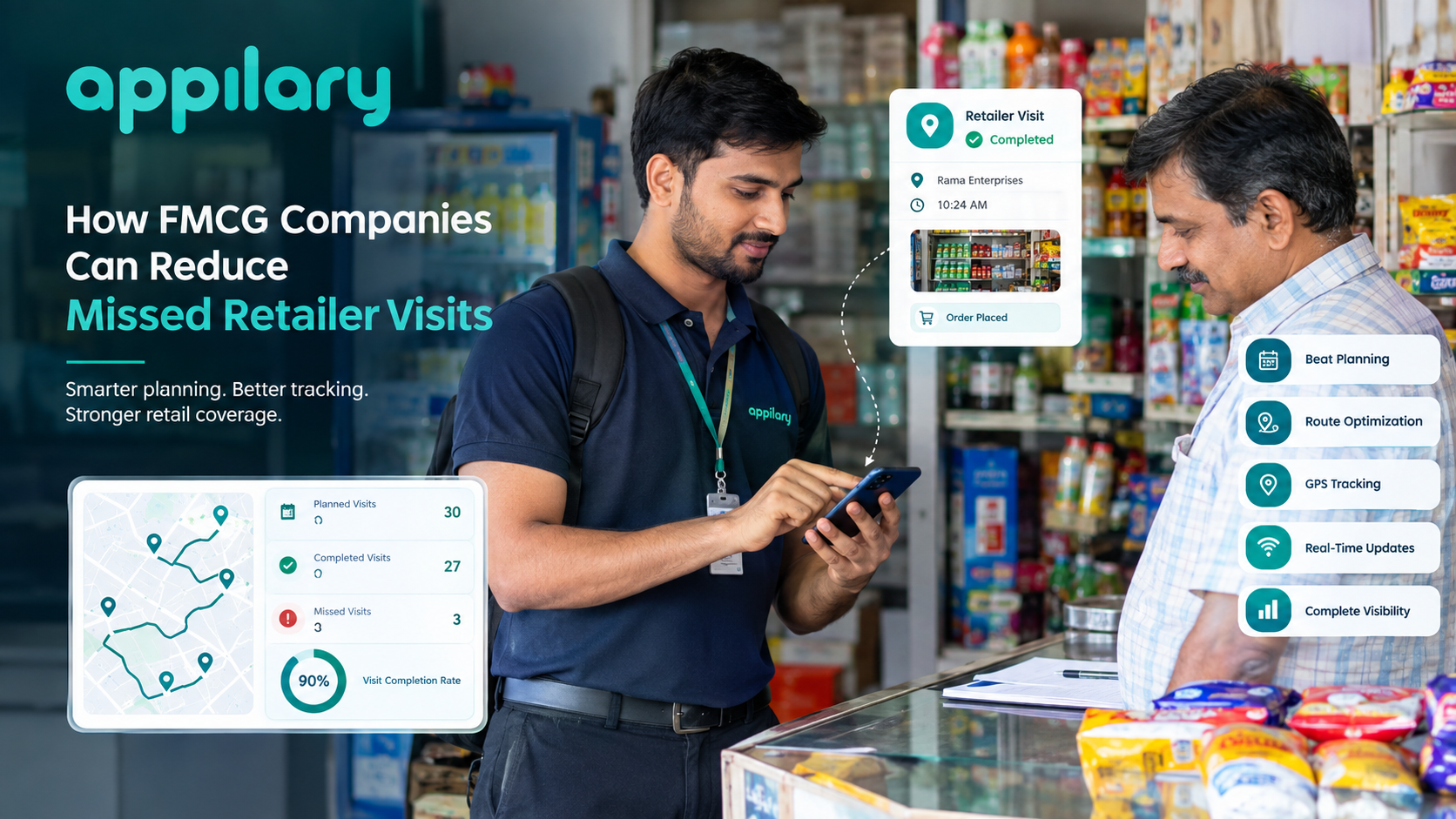
80 Planned → 72 Visited → 8 Missed → 90% Coverage
Managers can then investigate why the eight outlets were missed and make adjustments.
This creates a continuous improvement cycle rather than relying only on end-of-month reports.
Features That Help Improve Outlet Coverage
1. Retailer Management
A centralized retailer database provides sales teams with information such as:
- Retailer name
- Location
- Contact information
- Retailer category
- Assigned distributor
- Sales representative
- Visit history
- Order history
Keeping this information organized makes outlet planning easier.
2. Retailer Segmentation
Not every outlet needs identical treatment.
Companies can segment outlets based on sales potential, order frequency, location, category, or strategic importance.
For example:
Retailer Type
Suggested Priority
High-value outlet
High
Medium-volume outlet
Medium
Low-volume outlet
Standard
New outlet
Development
Promotional outlet
Campaign-specific
The exact frequency should be determined by the company's sales strategy rather than using one fixed rule for every retailer.
3. Beat Planning
A structured beat plan groups retailers into manageable routes or markets.
For example:
Monday: Market A
Tuesday: Market B
Wednesday: Market C
Thursday: Market D
Friday: Market A
This provides sales representatives with a predictable schedule.
4. PJP Management
A Permanent Journey Plan (PJP) defines recurring market or retailer visits.
It helps sales managers establish consistent coverage across territories.
PJP and beat planning can work together:
PJP = When to visit
Beat = Which outlets to cover
5. Route Optimization
Route planning can help representatives visit nearby outlets in a logical sequence.
This can reduce unnecessary travel and potentially increase the number of productive visits completed during the working day.
6. GPS-Based Visit Verification
Location-based verification can help businesses confirm that a planned outlet visit actually occurred at the expected location.
This provides stronger visibility than relying entirely on manually submitted reports.
7. Planned vs. Actual Coverage
One of the most useful metrics is the comparison between planned and actual visits.
For example:
Planned Outlets: 50
Visited Outlets: 46
Missed Outlets: 4
Coverage: 92%
This allows managers to identify coverage gaps quickly.
8. Order Capture
A visit becomes more valuable when sales representatives can capture orders directly from the field.
Order capture can connect outlet coverage with actual sales activity.
9. Visit History
Historical visit information can help managers understand:
- When an outlet was last visited
- How frequently it is being visited
- Orders generated
- Previous activities
- Coverage patterns
10. Real-Time Dashboards
Managers can use dashboards to monitor:
- Outlet coverage
- Planned visits
- Completed visits
- Missed visits
- Sales representative productivity
- Orders
- Sales targets
- Territory performance
This reduces dependence on manually prepared reports.
11. Offline Field Capability
FMCG teams often work in areas where internet connectivity can be inconsistent.
A field sales application with offline capabilities can allow representatives to continue recording relevant field activities and synchronize information when connectivity becomes available.
12. New Outlet Addition
Sales representatives should have a structured way to identify and add potential new outlets.
This can help companies continuously expand their retailer network rather than focusing only on existing outlets.
Benefits of Improving Outlet Coverage
1. More Productive Retailer Visits
Better planning helps representatives spend more of their working day interacting with retailers.
2. Higher Market Reach
A structured coverage strategy can help companies reach more relevant outlets across their territories.
3. Better Retailer Relationships
Consistent visits can help representatives understand retailer requirements and maintain stronger relationships.
4. Improved Stock Visibility
Regular retailer visits make it easier to identify stock shortages and replenishment opportunities.
5. Better Sales Execution
When the right outlets are covered consistently, sales teams have more opportunities to capture orders and execute promotions.
6. Reduced Travel Inefficiency
Geographically organized beats and optimized routes can reduce unnecessary travel.
7. Greater Field Accountability
Managers can compare planned activities with actual field execution.
8. Better Resource Allocation
Retailer segmentation helps companies allocate field resources according to business importance.
9. Faster Corrective Action
If a particular territory consistently has low coverage, managers can investigate and adjust the route, workload, or team allocation.
10. Scalable Sales Operations
Digital outlet coverage management becomes increasingly valuable as a company expands into new markets and adds more retailers.
Industry Use Cases
General Trade
FMCG companies can improve coverage of kirana stores and smaller retailers by organizing them into geographical beats and assigning appropriate visit frequencies.
Food & Beverage
Sales representatives can track retailer visits, orders, product availability, and merchandising activities across markets.
Personal Care
Companies can use outlet coverage planning to support product launches, promotions, shelf visibility, and retailer engagement.
Home Care
Field teams can organize outlet visits based on territory, retailer potential, product demand, and order frequency.
Dairy
Frequent retailer coverage can help sales teams monitor product availability, orders, and market requirements.
New Product Launches
Companies launching a new SKU can create specific outlet coverage plans to ensure target retailers are visited and the new product is introduced.
Retail Activation
Field teams can use structured outlet lists to execute branding, POSM, promotional activities, and photographic verification.
Distributor-Led Sales
Companies can coordinate sales representatives and distributor networks by mapping retailers to territories, distributors, and sales teams.
How Can FMCG Companies Improve Outlet Coverage Step by Step?
Improving outlet coverage does not always require adding more sales representatives. Companies should first optimize the existing sales operation.
Step 1: Clean the Retailer Database
Remove inactive or duplicate outlets and update retailer information.
Step 2: Map Every Outlet
Ensure each retailer has an accurate geographical location and territory assignment.
Step 3: Segment Retailers
Classify outlets according to sales potential, category, order frequency, and strategic importance.
Step 4: Set Visit Frequencies
Determine how often different retailer segments should be visited.
Step 5: Create Logical Beats
Group geographically close outlets into manageable beats.
Step 6: Build the PJP
Assign beats and retailers to specific days and recurring schedules.
Step 7: Optimize Routes
Create practical visit sequences to reduce unnecessary travel.
Step 8: Digitize Field Visits
Use a field sales application to record visits, orders, merchandising activities, and other relevant information.
Step 9: Measure Coverage
Track:
Planned Visits → Completed Visits → Missed Visits → Coverage %
Step 10: Analyze and Improve
Identify low-performing territories, frequently missed outlets, inefficient routes, and workload imbalances.
Then adjust the plan.
Conclusion
Improving outlet coverage in FMCG is not simply about visiting more retailers. It is about visiting the right retailers, at the right frequency, with the right sales activities, while using field resources efficiently.
A strong outlet coverage strategy combines:
Accurate retailer data + segmentation + beat planning + PJP + route optimization + field execution + performance tracking
Field sales automation can bring these activities together in one system.
Instead of relying on spreadsheets and manual reports, managers can understand which outlets were planned, which were visited, which were missed, and what sales activity happened during those visits.
For growing FMCG companies, this creates a more structured approach to market coverage and helps sales teams move from reactive field management to data-driven sales execution.
Ultimately, better outlet coverage can help FMCG companies strengthen retailer relationships, improve field productivity, identify market opportunities, and build a more scalable sales operation.